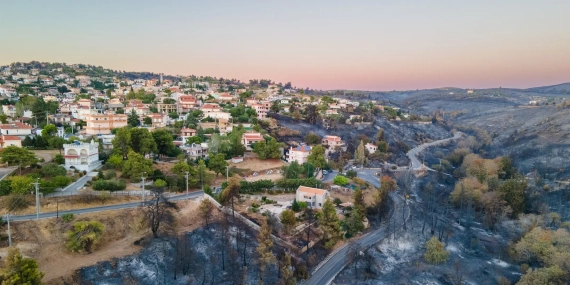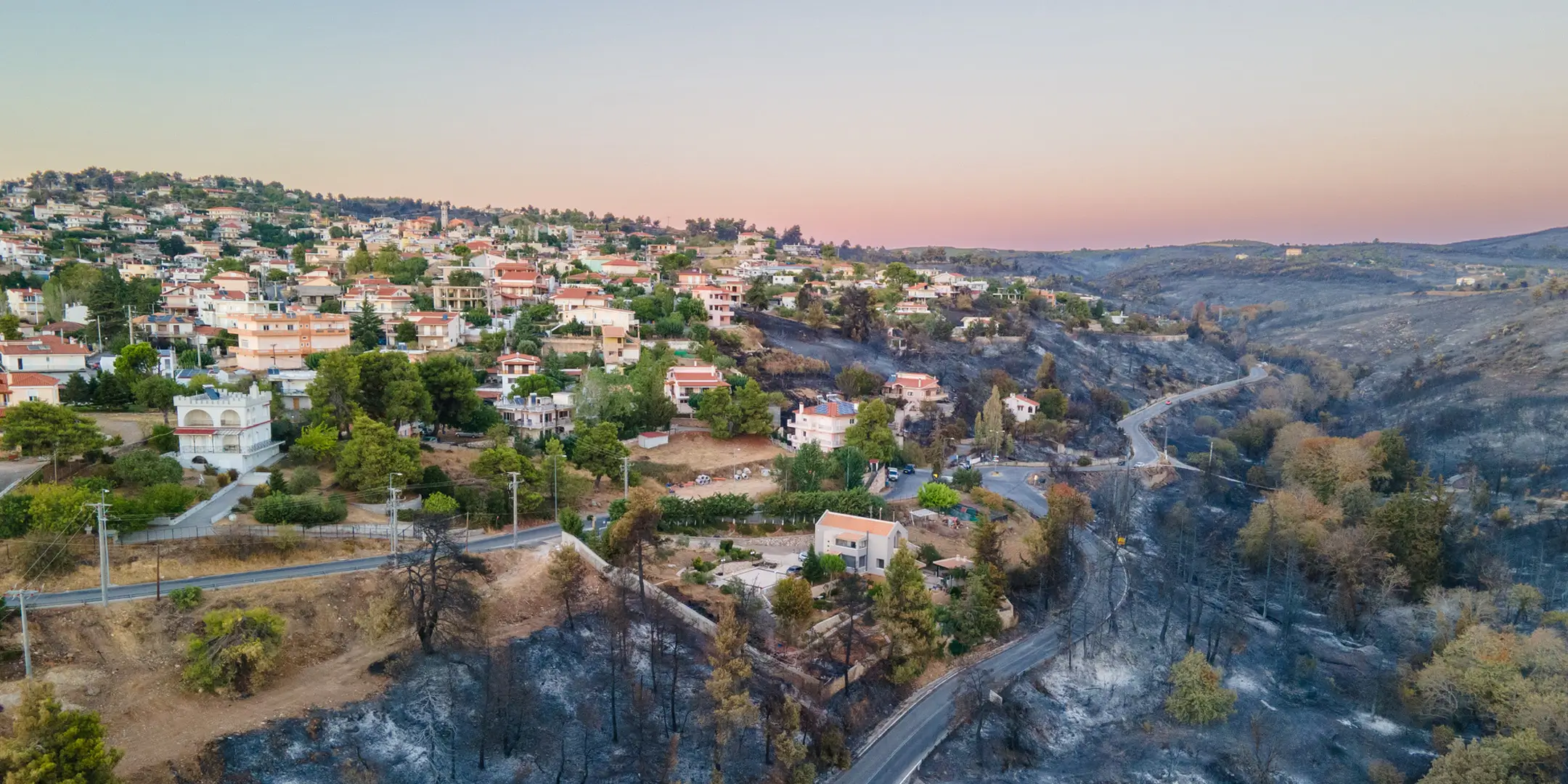
Climate X's analysis of 270 million properties finds that roughly 1 in every 60 properties across Europe could face a 1% annual chance of a serious wildfire by 2050, representing an estimated €360bn in damage costs.
LONDON, 13th August 2026 - Following the recent wildfires that threatened the outskirts of Bordeaux and Madrid, new analysis from climate risk intelligence firm Climate X highlights the scale of the wildfire risk Europe now faces, and points to areas where wildfire risk will change in the future.
Climate X's building-level analysis of 270 million properties across 31 European countries finds that nearly 4.9 million buildings could face a 1% annual chance of a serious wildfire by 2050. This represents almost 2% of all European building stock, or roughly 1 in every 60 properties, representing €360bn in building replacement value.
Over a typical 30-year mortgage, a 1% risk adds up to roughly a 1-in-4 chance of a wildfire hitting any one of these buildings.
Key Climate X Findings:
- ● Nearly 4.9 million European buildings, or roughly 1 in every 60 properties, could face a 1% annual wildfire risk by 2050
- ● Europe's property exposure could reach €360bn by 2050
- ● Portugal holds close to 60% of total EU wildfire exposure
- ● Percentage growth in risk is most extreme in Finland, Poland and the Baltic states, regions with historically negligible wildfire exposure
- ● In Athens, wildfire damage is projected to rise from €0.7bn to €1.0bn by 2050, a 38% increase

What we saw around Bordeaux and Madrid fits a pattern our data has pointed to for some time: wildfire risk is growing across Europe, especially in exposed communities within the urban-rural interface. This is where people live and work alongside fire-prone landscapes. That exposed area has already grown by 35% since 2000, and we expect the number of properties at risk to keep rising. "
Dr James Brennan, Director of Science at Climate X
 Dr James Brennan, Director of Science at Climate X
Risk Rises In Northern Europe
Portugal accounts for close to 60% of Europe’s total exposure, more than any other country. However, its risk levels are set to grow by only 1% by 2050 as so much of the nation is already exposed.
Risk is growing fastest across Finland, Poland and the Baltic states (Latvia, Lithuania, Estonia), as regions with historically negligible wildfire exposure are now beginning to register material risk. The number of assets exposed in Finland to a 1% wildfire risk will increase by 50% by 2050.
This widening risk area is already apparent. In 2025, Germany, Spain, Cyprus and Slovakia each recorded their worst wildfire year on record, and the UK had its worst season since monitoring began in 2012, including the largest wildfires ever recorded in Scotland. In Athens, exposure is projected to rise from €0.7bn to €1.0bn by 2050, a 38% increase driven by rising fire probability on existing buildings, not new construction.
Lenders and insurers need to treat wildfire exposure the same way they already treat flood or subsidence risk. It should be priced, monitored, and revisited over the life of the asset, not signed off once at the start. As reporting and compliance requirements tighten in Europe, climate risk scrutiny becomes a regulatory expectation rather than just good practice.”
Kamil Kluza, COO and Co-founder, Climate X.
With European lenders and insurers facing growing pressure to disclose forward-looking climate risk under CSRD (the EU's Corporate Sustainability Reporting Directive, which requires large financial institutions to disclose forward-looking climate risk), institutions that begin treating wildfire as a live, shifting input now will be better placed than those waiting for the next fire season to force the issue.
Wildfire Research Methodology
These findings draw on Climate X's Global Wildfire model, which assigns a burn probability to each of 270 million individual buildings across 31 European countries resolved to 30-metre resolution. Unlike index-based or purely historical approaches, the model produces burn probabilities rather than a relative risk score. The model simulates 50,000 fire footprints per location, resampled across 100,000 synthetic years to capture both typical fire activity and rare, extreme events. Future risk is projected under four IPCC climate scenarios using climate model projections of temperature and humidity changes. Asset-level financial exposure is calculated by applying each building's replacement cost and a damage ratio, determined by its roof, wall and eave construction.. The model has been validated against high quality US damage data and against historical fire events globally.
About Climate X
Climate X is one of the world’s leading climate adaptation and resilience firms, empowering financial institutions and real estate owners to turn climate risk into resilient returns. From London to New York, their team of climate scientists and financial risk experts delivers decision-ready intelligence with absolute clarity, quantifying exposure, translating it into financial impact, and mapping the path to ROI for resilience.
Trusted by institutions managing over $13.5 trillion in assets, including a top-3 North American bank, a global top-3 private equity firm, a top-3 Global P&C insurer and leading global consultancies like Deloitte and Bain & Company, Climate X is setting the global benchmark for how organizations de-risk the future and unlock climate-aligned growth. To learn more, visit https://www.climate-x.com.
Get the Full Story: Growing Wildfire Risk in Europe
Download the full report to see how wildfire exposure builds across Europe to 2050, country by country and city by city, and what that means for underwriting, pricing, and portfolio strategy today.
What's included in the report:
Scale of European wildfire exposure today and to 2050
Country-level exposure and fastest-growing risk markets
Athens and Marseille case studies at the building level
Global Wildfire model methodology
Implications for lenders, insurers, and asset managers
Latest Articles & News
A selection of some of our latest articles covering industry, policy and climate science - written by us.