Lessons from a conversation with Orbis Advisory and CIP Fund Solutions on infrastructure physical risk.

TL;DR
- Infrastructure physical climate risk is shaped by distributed footprints, asset-type sensitivity, and interdependencies that can amplify disruption.
- Decision-useful assessment goes beyond hazard identification to how the asset responds, where failure points sit, and what that means for diligence.
- In this conversation with Orbis Advisory and CIP Fund Solutions, we unpack why hazard-only screening underdelivers, how to avoid false precision, and what to look for from risk data vendors.
Audio Deep Dive
Duration: 21 minutes

Climate X

Orbis Advisory

CIP Fund Solutions
Infrastructure physical climate risk is harder than real estate to assess because assets are spatially distributed (networks and corridors), outcomes depend on asset-specific vulnerability, and small component failures can drive disproportionate operational and financial impacts.
In a recent discussion with Naga Suresh, Head of Advisory at Orbis Advisory, and Dominik Varga, Senior Associate in the ESG team at Copenhagen Infrastructure Partners (CIP) Fund Solutions, we explored what makes infrastructure risk assessment genuinely decision-useful, and why infrastructure physical climate risk demands a different approach to the tools and frameworks most investors have to hand.
For investors and advisors who need to translate climate analytics into due diligence conclusions and investment committee conversations, we've summarised the key themes that came up.
3 Layers of Complexity That Infrastructure Screening Often Underestimates
"Infrastructure" is an umbrella term. A solar park, a gas pipeline, and an offshore wind farm may sit in the same allocation bucket, but they behave very differently under physical hazards and require different modelling assumptions. Across climate change risk assessments for infrastructure, three recurring sources of complexity arise:
01
Spatial Precision
Infrastructure assets are not always a single point
A building has a footprint and can be defined by a single latitude and longitude, whereas many infrastructure assets are corridors, networks, and multi-site systems. For example, a transmission line crosses multiple microclimates and an offshore wind farm has offshore turbines, onshore substations, and cabling connecting them. For these assets, exposure is rarely a single coordinate. Instead, it's distributed across components and geographies.
02
Asset-Type Sensitivity
Hazard does not equal risk
The same hazard intensity can lead to very different outcomes depending on how an asset is built and operates, including design, elevation, materials, protection measures, and operational tolerances. For example, a flood event affects a buried pipeline differently from a ground-level substation. Without this layer of asset-specific context, a hazard overlay is best described as exposure mapping, not a risk assessment.
03
Component-Level Dependencies
Small failures can drive large losses
Infrastructure performance is often determined by critical components and interdependencies: access roads, substations, control systems, grid connectivity, and downstream service dependencies. An asset can be physically intact yet functionally offline due to a single affected component. This is one of the defining characteristics of critical infrastructure risk and one of the reasons standard real estate frameworks fall short when applied to infrastructure portfolios.
The Misconception That Derails Many Assessments: Stopping at Hazard
Naga described a common gap in market practice, that is, treating hazard intensity as the conclusion, rather than the starting point.
If you just look at the climate hazard… that's only part of the picture. You really need to understand how the asset will behave when faced with this particular hazard."
Naga Suresh, Head of Advisory, Orbis Advisory
A growing number of frameworks and stakeholders now expect firms to demonstrate more than hazard exposure, inclduing how assets are likely to respond, where failure points sit, and what that means for continuity and materiality. It is also becoming central to investment decision-making. Without it, outputs can be difficult to defend when stakeholders ask the questions that matter: what breaks, under what conditions, and what does that mean operationally?
False Precision Is Often a Bigger Problem Than Uncertainty
Dominik raised a point that anyone working on infrastructure physical climate risk will recognise, that outputs can look precise without being decision-useful.
If you give someone a climate risk score of 7.3 out of 10, what does that actually tell you?"
Dominik Varga, Senior Associate (ESG), CIP Fund Solutions
A single score without clear assumptions, context, and uncertainty ranges can create the wrong kind of confidence. Infrastructure risk assessment involves real modelling choices, from scenarios and time horizons to return periods and the assumptions that sit between hazard and decision-useful outcomes. Different vendors make different choices, and those choices can be appropriate for different use cases. What matters is whether an investor understands what was measured, how it was measured, and how to interpret it.
The Translation Problem: From Climate Analysis to Investment Materiality
Even when exposure and vulnerability are well characterised, many assessments stall when it comes to financial interpretation. This is where infrastructure investment risks become real to deal teams and investment committees, and where the sustainability function either earns its seat at the table or gets filed in the annexes.
Naga shared a pipeline example that illustrates the difference between direct and total impact. Flood exposure on a critical infrastructure asset is not only a repair cost. It can include delayed maintenance, access routes becoming unusable, service disruption, and cascading downstream consequences across healthcare, utilities, and transport. Those second-order impacts often determine whether the risk is financially material, and they rarely appear in a simple hazard score.
That really is when you start getting buy-in… when you're able to speak the language of finance… with the CFO, with investment committees."
Naga Suresh, Head of Advisory, Orbis Advisory
For infrastructure, metrics like AAL (Average Annual Loss) can be useful as a threshold indicator. But Naga emphasised the importance of looking beyond averages to identify failure points and concentrated tail risks, particularly where interdependencies create outsized consequences.
Infrastructure assets don't behave like buildings. A pipeline, a wind farm and a transmission corridor each have a distributed footprint, component dependencies, and failure modes that standard real estate tools weren't designed to capture. Our Infrastructure Screener is built for that complexity.
See our Infrastructure Screener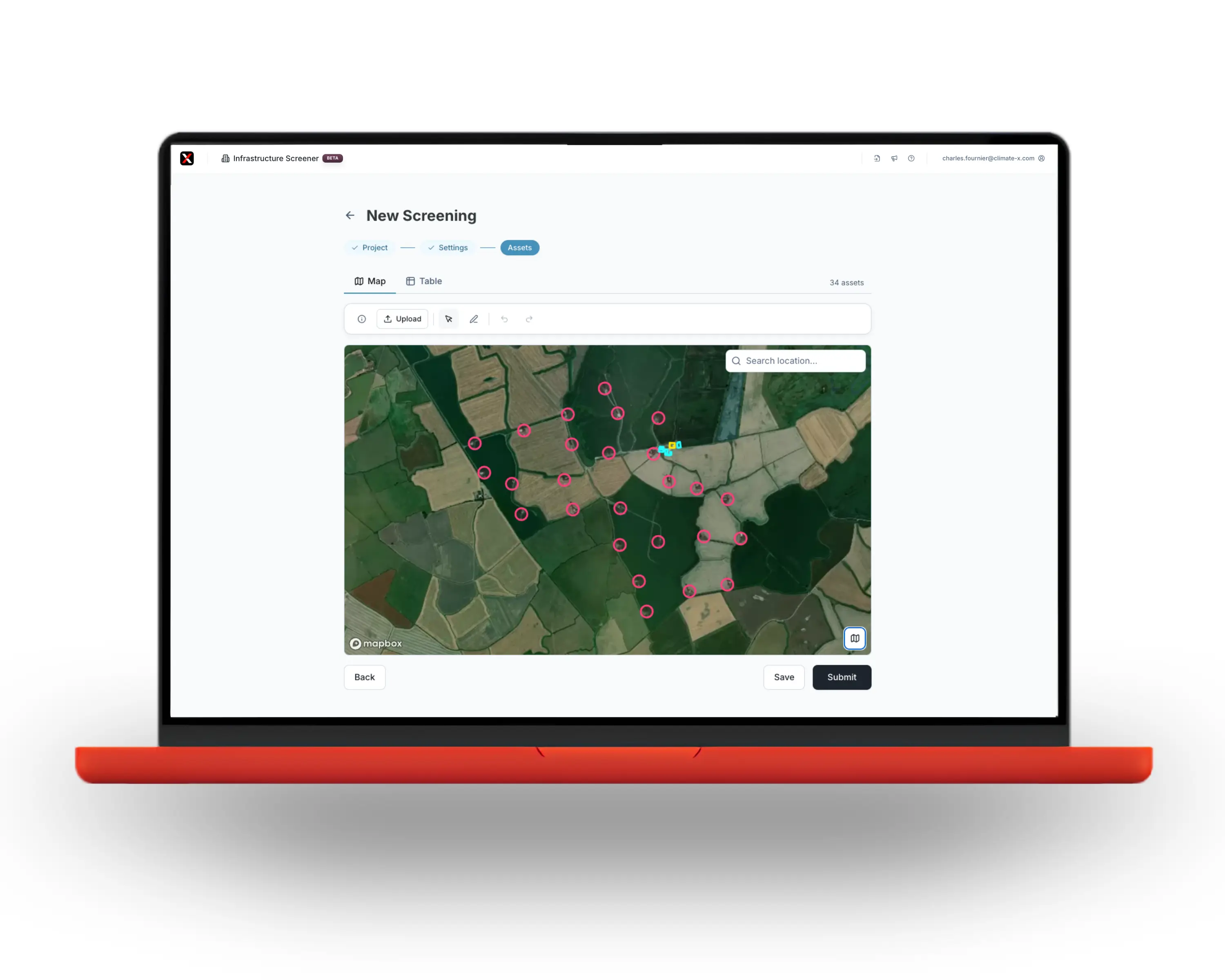
What Investment-Committee Ready Outputs Look Like in Practice
Dominik was direct about the difference between analysis that informs decisions and analysis that gets filed away.
If you produce outputs which are pages and pages long… you will produce something for the annexes."
Dominik Varga, Senior Associate (ESG), CIP Fund Solutions
The workflow that tends to work better is: start with robust model outputs, apply analyst judgement, and distil insights into a defensible chain, with uncertainty stated clearly.
This is what enables productive investment discussions before an IC meeting, rather than introducing infrastructure investment risks as a late-stage surprise.
Adaptation Is Becoming a Core Part of the Infrastructure Conversation
The panel also discussed how adaptation planning is evolving. Increasingly, the question is not whether to consider adaptation, but how to prioritise and justify it, which puts resilient infrastructure and disaster risk planning firmly in the investment conversation, not just the sustainability one.
The key theme that comes up is that adaptation measures are far more effective (and easier to defend) when they follow a structured infrastructure risk assessment, covering hazards, vulnerability, operational impacts, and financial implications, rather than being planned in isolation. For many assets, adaptation decisions also require multi-stakeholder coordination (local authorities, landowners, communities), which can change both feasibility and cost.
The Practical Vendor Test for Infrastructure Climate Risk Screening
When evaluating physical risk providers for infrastructure, Dominik highlighted a simple question that often reveals whether a methodology matches the asset class: are they modelling the asset footprint with polygons and components, or treating it as a point with a radius? Point-based approaches can miss the spatial reality of linear assets, multi-site renewables, and network dependencies. From there, additional diligence questions follow naturally:
- Is the methodology documented and available?
- Can you speak with the analysts behind the outputs?
- Do results align with what you would expect from a sample asset you already understand operationally?
In the end, we're making decisions under uncertainty… Our job is to determine whether the risk is financially material and then act accordingly."
Dominik Varga, Senior Associate (ESG), CIP Fund Solutions
Next Steps
At Climate X, our infrastructure screening module within Spectra is designed for the realities of infrastructure physical climate risk: spatially complex footprints, component-driven exposure, and decision-making across time horizons. It supports polygon-based screening and component-level granularity, helping teams move from a single hazard score to a clearer, defensible view of what is driving exposure and where hotspots sit. Whether you're building a climate risk screening process from scratch or pressure-testing your current approach to infrastructure physical climate risk, we'd welcome the conversation.

Common questions on infrastructure physical climate risk.
How is physical risk assessment for infrastructure different from real estate?
Infrastructure often involves distributed footprints (corridors and networks) and component dependencies (substations, access routes, cabling) that carry their own exposure. That means a hazard can leave a primary structure intact but still disrupt operations if a critical component is affected; methods adapted from real estate can miss these key pathways from exposure to operational impact. This is why infrastructure screening typically requires higher spatial precision and asset-specific vulnerability assumptions.
What are the most common use cases for physical climate risk analysis in infrastructure?
Physical risk analysis is typically used to support decisions across the investment lifecycle, including:
- Pre-acquisition screening: prioritising which assets need deeper diligence and which hazards to focus on.
- Due diligence and IC preparation: stress-testing assumptions, identifying key vulnerabilities and dependencies, and summarising decision-relevant findings.
- Asset management: targeting resilience measures, operational planning, and monitoring of key exposure drivers over time.
- Stakeholder communication: providing a clear, defensible narrative for internal stakeholders and external reporting where relevant.
The most useful outputs connect spatial exposure to asset-specific vulnerability and operational impact so teams can decide what to do next, not just catalogue risk.
How should investors evaluate climate risk vendors for infrastructure?
Start with methodology transparency: is it documented, available on request, and can you speak to the analysts behind it? Then check spatial precision; vendors working with polygons rather than point-based assessments can provide more decision-relevant precision for assets with complex footprints. Also, ask how vulnerability is modelled and validated for the asset type. Finally, test outputs against assets you already understand well. If the results don't rationally match your operational knowledge of those assets, that's a signal worth investigating before you rely on the data at scale.
Our Latest Articles & News
A selection of some of our latest articles covering industry, policy and climate science - written by us.