TL;DR
- Dr James Brennan, Director of Science at Climate X, assesses how the number of extreme heat days changes across Europe between now and 2050.
What the modelling reveals is that risk isn't rising evenly. Southern Europe carries the heaviest burden, with Iberia, southern Italy, Greece and the western Balkans exceeding 40 to 55 extreme heat days a year by 2050, while central Europe emerges as a new heat stress zone.
No European region sees a reduction in extreme heat days by 2050 under SSP5-8.5. The steepest increases, 25 to 35 additional days, fall on the regions already most exposed.
Learn how companies are already evaluating their exposure to extreme heat and quantifying revenue at risk or adaptation ROI using physical risk data from Climate X.

Climate X
What Is Extreme Heat?
Extreme heat is defined as a period of unusually high temperatures that are significantly hotter than normal for a specific location and time of year, often lasting multiple days.
Importantly, the threshold will vary for different locations; an extreme heat day in Oslo is very different from what constitutes one in Seville, because people, infrastructure and behavior have already adapted to high temperatures.
While many hazards are easily visible, extreme heat is a quiet disrupter. These hot periods affect business operations through absent workforces, strained supply chains and utilities under stress, while leaving a heavy social toll in excess mortality, hospital admissions and pressure on health services. By the time business costs surface, the connection to a heatwave months earlier has usually been lost.
The problem is that much of Europe is not yet well prepared for this. European air conditioning remains rare across the continent's homes and workplaces, particularly outside the south, and housing stock, transport networks and power grids are vulnerable to sustained high temperatures. That gap is already hitting the European economy financially. Triodos Bank warns that this summer's extreme heat and drought could reduce EU GDP by around €180 billion in 2026, close to 1% of the total, with lost labor productivity the largest driver alongside higher food and energy prices and transport disruption.
Climate X analysis shows how the number of extreme heat days is projected to grow to 2050, highlighting where the sharpest increases occur and why the risk now reaches well beyond the regions already built for it.
Lean where extreme heat could affect your business value chain.
The European Picture to 2050
Climate X's Extreme Heat Hazard Model projects how the number of dangerous heat days changes at any location out to 2100. Under SSP5-8.5, a high-emissions scenario used to stress-test assets against severe conditions, the mid-century outlook reshapes the map of European extreme heat risk.
What Is SSP5-8.5?
SSP5-8.5 is a high-emissions climate scenario in which global greenhouse gas emissions continue to rise strongly through the 21st century, driven by fossil fuel dependence and energy-intensive economic growth, reaching a radiative forcing of 8.5 watts per square metre by 2100. It represents the upper bound of projected warming and is commonly used in physical climate risk assessments to stress-test assets and infrastructure against the severest future conditions.

By mid-century, extreme heat days are no longer a southern European phenomenon. The gradient that in 2025 ran sharply from cool north to hot south has flattened considerably, with heat stress spreading deep into central and eastern Europe. Climate X data reveals the following:
- Southern Europe bears the heaviest burden
The Iberian Peninsula, southern Italy, Greece and the western Balkans see the most severe conditions, with many NUTS3 regions exceeding 40 to 55 heatwave days per year by 2050. Portugal's southern interior and coastal Andalusia in Spain show the highest values on the map. The Mediterranean coast, from Catalonia through southern France, Liguria, and down through the Italian Mezzogiorno to the Greek archipelago, forms a continuous high-heat corridor.
- Central Europe emerges as a new extreme heat stress zone
France, the Po Valley in northern Italy, Hungary, Romania and the western Balkans see a substantial shift from mild to moderate-high heat exposure. Regions that recorded 5 to 10 days in 2025 are approaching 20 to 30 days by 2050: a doubling or tripling of exposure within a single generation.
- Northern Europe remains comparatively protected but is not insulated
Scandinavia, the British Isles and the Baltic states still sit at the cooler end of the scale, but even here the baseline has shifted upward from near-zero in some areas to low single figures.
The Change Map
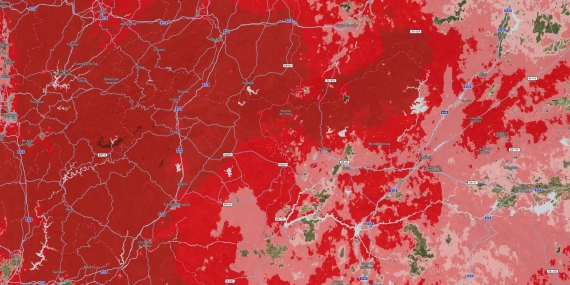
The change map tells a more differentiated story. The largest absolute increases (shown in deep red) are concentrated in southern and south-eastern Europe, where regions already under heat stress are accumulating an additional 25 to 35 days of extreme heat above their 2025 baseline. This is a compounding risk, meaning the places already most exposed are seeing the fastest acceleration.
Central Europe shows moderate but significant increases of 10 to 20 additional days, affecting densely populated and economically active regions in France, Germany's south, and Austria.
The near-absence of blue on the change map is itself a finding: there are no regions in Europe that see a reduction in extreme heat days under SSP5-8.5 by 2050. This is a uniformly worsening picture across the continent, with only the magnitude of change varying by geography.
What This Means for Portfolio Holders
For a financial institution, the hazard itself is only the starting point. Losses arise where that hazard meets exposed, vulnerable assets or channels.
Heat hits value through 3 different channels:
- Productivity and revenue.
High temperatures and extreme heat can reduce labour productivity and, in some circumstances, halt activity altogether. Construction, manufacturing, logistics and other labour-intensive sectors can be particularly exposed, turning lost working hours into lower output and revenue.
- Operating costs and asset performance.
Rising cooling demand can increase energy costs across commercial real estate, data centres, warehouses and other facilities, often at the same time that electricity systems are experiencing higher demand. Sustained extreme heat can also affect physical infrastructure, from rail networks and roads to equipment designed around historically cooler operating conditions.
- Longer-term asset and financing effects.
As exposure becomes more apparent, adaptation requirements can increase capital expenditure. Insurance availability and pricing may change, while recurring operating impacts can feed through into asset valuations and financing decisions.
The financial transmission mechanism differs by asset class. For real estate, higher costs and changing tenant demand can affect net operating income and valuation. For lenders, deteriorating asset performance can affect collateral and borrower resilience. For infrastructure and private markets, heat exposure can alter operating assumptions, capital requirements and ultimately investment returns.
By 2050 the fastest acceleration in exposure is happening in the central European regions that hold a large share of the continent's economic activity, and where assets are least prepared for it. For anyone holding property, infrastructure or lending exposure across Europe, what matters is which assets are exposed, by how much, and what it costs to prevent negative financial impact.
See how firms are quantifying and incorporating business disruption risk metrics into due diligence and portfolio monitoring. With insights from KPMG and Macquarie
See How Extreme Heat Could Impact Your Business
Evaluate your business exposure to extreme heat risk with Spectra, the climate risk platform developed by Climate X. Model hazard exposure, projected down days or productivity impact and quanitify your revenue at risk.
The Adapt module then determines the ROI of pre-emptive adaptation action across 22 different interventions, so resilience spend can be justified against the losses it avoids.
Our Latest Articles & News
A selection of some of our latest articles covering industry, policy and climate science - written by us.